Wednesday, February 29, 2012

Anchors Aweigh . . .

On August 6, 1967, I left on the train for boot camp, rode to New York, and reported to the induction center at Whitehall Street (the very same Whitehall Street made famous by Arlo Guthrie in "Alice's Restaurant, originally released in that same year!).  After getting sworn in, a whole group of us brand new sailors boarded another train for Great Lakes Naval Training Center in Waukegon, IL.  The trip took all night, and the US taxpayers fronted each of us a sleeping berth on the train, the one, and so far only, time I have ever enjoyed such luxurious rail accommodations.

Didn't sleep a whole lot though.  Kept wondering throughout the country side if perhaps I hadn't made some sort of horrendous error in judgment (a suspicion confirmed less than 24 hours after enlisting, and then in some four years of consequences. . .)


The Quarterdeck Of The Navy!

 I found out this morning on Wikipedia that Great Lakes was known as "the Quarterdeck of the Navy."  The quarterdeck on a ship, if I remember correctly, is the area where one first comes on board.  How appropriate to designate Great Lakes with this honorific . . .

Great Lakes was also known by another, less honorable, but perhaps more accurate, honorific, one definitely much more appropriate for one such as I, and also one which I can't believe I never heard until this morning, in the same Wikipedia article-- it was also called "Great Mistakes . . ."

Uniforms were issued the second day, but in the next 8 weeks, I lost 25 pounds, so nothing fit by the time boot camp was over, when I would have only had three years and 44 weeks left until my enlistment was over, except that also during the first week, I had signed a two year extension so I could be guaranteed a slot at an extended electronics school (Fire Control Technician, for Polaris submarines!).  By week three, I had come to realize my mistake, and begun to appreciate that sometimes the consequences of our decisions were far out of proportion to the decisions themselves . . .

In boot camp, because of my previous affiliation with the Catholic Church, I was designated as the "Catholic Religious Petty Officer."  My nickname immediately became "Padre."  On Sunday mornings, it was my job to march all the Catholics to church.  Attendance was mandatory.  Seems we still had freedom to worship, we just didn't have freedom to not worship anymore.  And at church in boot camp, over the 8 weeks I was there, I ran into three other LaSalette alumni. 

I learned a lot in boot camp.  It was a lot like the seminary.  We all got up at the same time, ate at the same time, did everything together, and all answered to the same higher authority.  The major difference was the new vocabulary one used to describe everyday events and occurences . . . 

I re-learned how to tie some of the same knots I'd learned in boy scouts.  I learned the "general orders of a sentry."  I learned how to make a flotation device out of my pants.  And I learned how to march.  Marching was my favorite-- it didn't take a lot of thought.  After a while, I could do it in my sleep. 

Boot camp ended in October, 1967, and we all got two weeks leave, that we hadn't earned yet.  Which was fairly uneventful, until the night I asked my mom to pass the 'effin' butter.  Then I reported back to Great Lakes to begin Fire Control Technician A School.  Now I only had 5 years and 44 weeks until I would be a civilian again . . .

Tuesday, February 28, 2012

God rules . . .

 My earliest memories about God are  from kindergarten, which was in 1953, at Edgar C. Stiles public elementary school on Main Street in West Haven.  It was the year before I went to St. Lawrence.  Edgar C. Stiles was just under a half mile from my house.  Had to cross Elm Street, and the intersection at Wagner Place and Main Street.  But there was a traffic cop, named Mac, at Main, and no one ever got run over.  I used to walk to school, and walk home.  By myself.  At the age of five.  Truly, it was a different world then . . .

My teachers were Miss Skinner and Mrs. Jorgenson.  As part of the curriculum, we were taught the Lord's Prayer-- I know, I know.  Hard to imagine, isn't it? . . . but those were the good old days, before God got kicked out of public school.  In Matthew 6: 13, the King James Version reads: "And lead us not into temptation, but deliver us from evil: For thine is the kingdom, and the power, and the glory, for ever. Amen."

And that was what they taught us.  Initially.  After we'd learned it, and had gotten used to saying it in unison each morning, I got a surprise.  One morning, Miss Skinner told me "Bruce, you're Catholic.  You don't say the 'for thine is the kingdom' part.  You stop after 'evil' and come back in at 'Amen,' ok?" 

"But I like that part!" I protested.  "But you're Catholic, and you don't say that part," she answered.  I think I remember asking "why not?"  But I don't remember if the answer ever went beyond "because you're a Catholic, not a protestant."

So, I'm five years old, and they're teaching me to talk to God- the King Of The Universe, but they're telling me that because of what I am, there's a specific way, specific words I have to use, other words I can't use  when I do it.  Might have been the first time I went to hell.

That was the year I learned the pledge of allegiance too.  And again, just when we had it down, they changed it.  This time, they stuck "under God" in the middle, right after "one nation."  Think I could remember that?  Took a week to get it in the right place consistently.

Right off the bat, I learned that God was very complicated.  "You have to say it this way.  You can't say it that way."  Why?  Because you're Catholic! Only the protestants say it that way, not the Catholics. So I wonder . . . does God not like Catholics?  Does He like protestants better? Is that why He won't let us finish the prayer that they get to pray?  And why didn't they just teach us the pledge the right way in the first place?  Was God angry that we'd left Him out?  And how did they know? 

Then I went to St. Lawrence, and as the years went by, God just got more and more baffling.  And the more I tried to find clarity the more confused I became.  Hence my aversion to going to hell on an ongoing basis. 

Why didn't God have the same rules for everyone?

Why, indeed . . .

Sunday, February 26, 2012

You can't stop me . . .

Once I left seminary, I tried to keep an interest in being a Catholic, but my heart was increasingly not in it.  All the stuff about changing from Latin to English (or, "vernacular," as the priests liked to say) happened around the time I was a junior/senior in high school.  By the time I left, even St Lawrence was on board.  Given my background and training, I was immediately drafted to be a "commentator" at one of the Sunday masses.  I suspect it was more because no one else wanted to than because I exhibited any particular closeness to God or oratory skill.

Kind of like Jerry Eyestone, Bentley Bros. Circus ringmaster used to say when reporters asked him how he got to be a ringmaster . . . "well," he'd say, "on the day I got here, all the good jobs were taken . . ."

I wasn't exactly a favorite.  My habitual late nights on Saturday left me suffering from "Chronic Sunday Fatigue Syndrome."  After falling asleep several Sundays in a row during the sermon, I got me a good talking to, and about went to hell.  But there wasn't anyone else stepping up, so I kept my position until August.

Sleeping in church, especially during the sermon, has always been kind of frowned upon.  By pretty much everyone, because most everyone else there is trying to stay awake, and seeing someone else getting away with something you'd desparately like to be doing can be irritating. Especially to priests and nuns, and really "devout" Catholics.  But sleeping during the sermon while you were the commentator?  Especially when you were up there, inside the rail, so to speak?  In full view of everyone?  That brought out a certain redness in the cheek of the aforementioned "devout."

But it also got a laugh . . .

During the days between flunking out of SCSC and August 6, 1967, I was working at Union New Haven Trust Company, George Street Branch.  It was a bank, I was a teller.  It had been my summer job, between when I graduated and went off to Altamont.  It was a lot better than my previous summer job, which was working for the city of West Haven at Painter Park.  There I had eight hours each day to put two foul lines and batters boxes on the baseball field for the evening's game.  The bank was air conditioned . . .

Because I'd been there the previous summer, and once again, because the position was unfilled, I was the "acting" head teller.  I had somewhere between $100,000 and $110,000 that I was responsible for, every day.  Once I left $27,000 in a drawer over the weekend (I forgot it was in there, and never put it in the safe).  It was still there on Monday, and I never told anyone at the bank.  But I sure didn't sleep through the sermon that Sunday.

Around July, my mom asked me when I was going to register for fall classes.  "I'm not," I said.

"And just what do you think you're going to do?" she wanted to know.

"I'm going to join the Navy!"  I answered.

"Oh no you're not!" she insisted.

And full of the same kind of bravado that my brother must have felt over the nail-polish, I replied, "Oh yes I am!  I'm over 18.  I'm a man now!  And YOU CAN"T STOP ME!"

And she didn't. 

Saturday, February 25, 2012

Southern Connecticut State College . . .

In January, 1967, I went back to college.  I enrolled in Southern Connecticut State College, which seems to have been the college that everyone who couldn't get into the college of their choice went to.  For me, it was the college of my choice.  Or, rather, the college of my mom's choice.  I personally would have chosen to disappear.   SCSC is now SCSU, and here's a photo of how it looks today . . .


It was a lot smaller in January, 1967 . . .

One of those buildings is the student center, which housed the cafeteria, wherein I spent a lot of time, as I didn't go to class a lot.  One morning,  I noticed a rather bizarre looking individual who came in and sat at a table across from me.  He had the longest hair I'd ever seen on a man, bell-bottom levis, a loud print dashiki style shirt, sandals, no books, and no food, and a slightly wild-eyed look about him.  On each table, there were salt and pepper shakers (see Fig 1)


 There was also a napkin holder (see Fig 2)

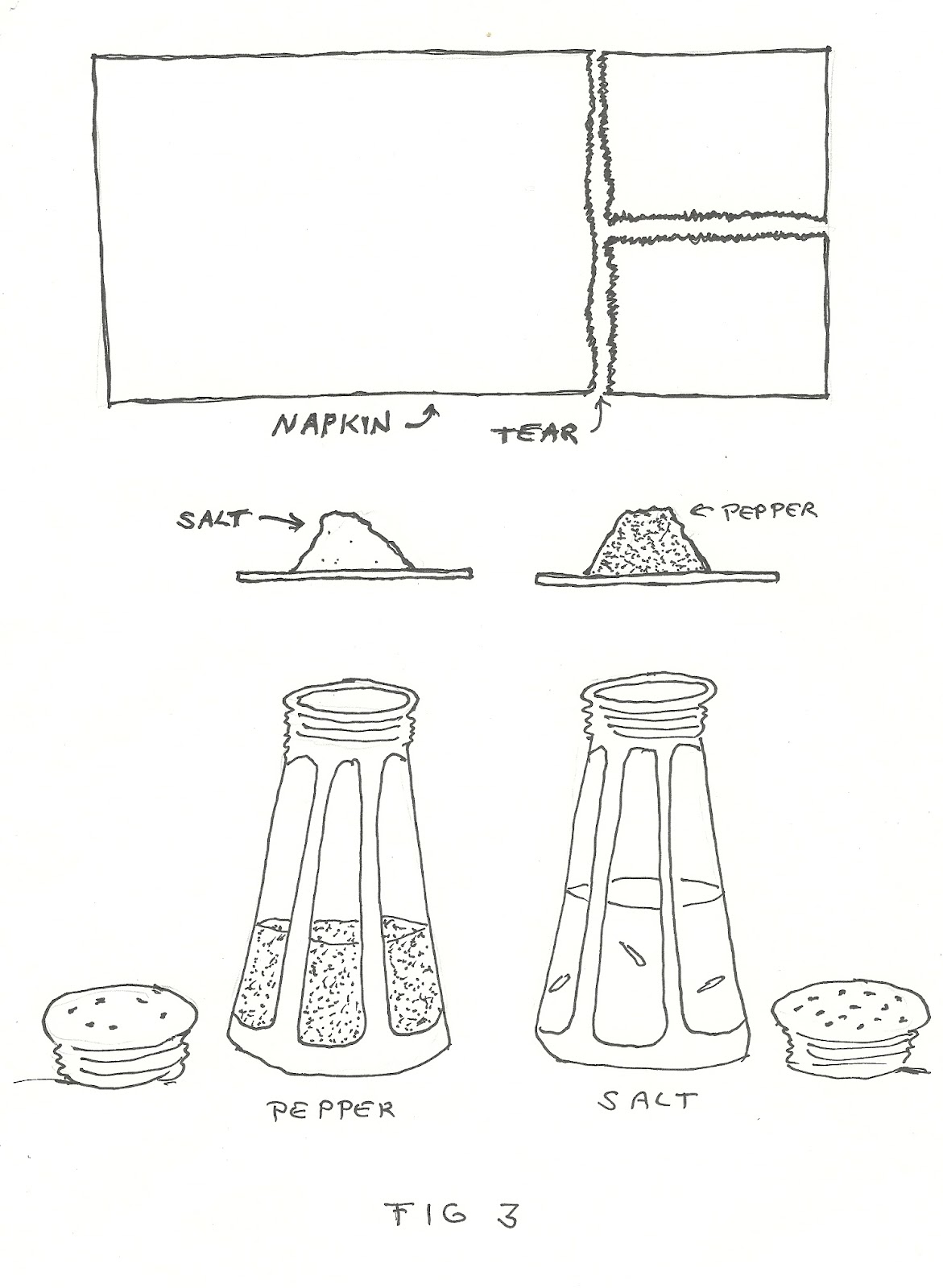
This wild-eyed individual proceded to remove one napkin from the holder and tear it as suggested in Fig3.  He also removed the tops from both the salt and pepper shakers, and dumped out a quantity of each onto the napkin fragments previously prepared (see Fig 3).

Then he inserted the napkin fragments with their quantity of condiment, each into the top of the opposite container . . . (see Fig 4)


Then he screwed the tops back on each shaker, tore off any protruding napkin chads and left the doctored condiment containers in their usual position by the napkin holder (Fig 5)

Then he got up, moved to a different table, and repeated the process.  Eleven more times, within about an hour.  He finished just as the lunch rush was descending on the cafeteria, stood up, looked around, smiled at me, winked, and left.

I don't know who he was, and I never noticed him again.  But since I'd already missed Botany and half of Baroque Music, and figured I was destined to fail both anyway, I remained where I was to see what would happen.  Some people were so intent on other things that they never even noticed.  They just seasoned their food, ate, and moved on. 

Some were greatly perplexed, bewildered at the salt that spewed pepper, and the pepper that spewed salt.  One guy shook out salt that came out pepper, shook out some more into his hand, then picked up the pepper shaker and shook out some salt into his hand, then seasoned his food and went on.

The funniest was the guy who tried both, got angry and then twice moved to other "doctored" tables, only to encounter the same phenomenon repeatedly.  All in all, it was for me, time well spent.

I learned more about intentional comedy in that lunch hour than I was ever going to learn about Botany or Baroque music.

For instance:
  1. Intentional comedy takes preparation.  Wild-Eye was willing to put in the time to perpetrate an effective bit of business on an unsuspecting public.
  2. Intentional comedy takes inspiration.  Without the idea behind it, nothing funny happens.
  3. Intentional comedy requires an opportunity.  A good comedian waits for, seeks out, creates opportunities.
  4. Intentional comedy is exaggerated.  He set up not one or two, but twelve tables! 
  5. Intentional comedy requires confidence in one's inspiration and use of the available opportunity.  Wild-eye left without ever seeing the results of his shennagans (great word, huh?). 
I failed Botany, and Baroque Music.  And I flunked out of SCSC.  But what I learned about intentional comedy in that two hours in the cafeteria?

Priceless.


Friday, February 24, 2012

Alpha-Jazz . . .

When I think about LaSalette, the person I think about most often is a guy named Al Jasnocha.  Alfred L. Jasnocha, Jr.  He was the youngest of thirteen children and the only boy.  This is him in high school.

He's the shorter guy in the middle, in the plaid shirt.  He was a year ahead of me in Cheshire, and he left from Altamont about a month or so before I did. 

He was a superb athlete.  He played baseball and basketball and was outstanding at both.  I remember being sick in the infirmary in my freshman year, and he was in the next bed.  There was a basketball game that night, and Fr. Caffry told him early in the afternoon that if his temperature was normal at dinner time, he could play.  His temperature came out at exactly 98.6 . . . he did it with an ice cube and a flashlight, as Fr. Caffry was out of the room during the three minutes . . .  Al played, we won, and he was back in the infirmary after the game with a temp of 102.  There was a little girl, someone else's sister, who heard some people call him Al, and some call him Jazz.  She named him "Alpha-Jazz" and it kind of stuck, in my head at least. 

When he decided to leave from Altamont, it seems no one thought it was a good idea.  They tried to talk him into staying.  Asked him to take some time to think about it, to make sure it was the right decision.  But he left anyway, and the place was devastated.  He was the kind of guy that if you couldn't be him, you wanted to be like him, and if you couldn't be like him, you'd settle for being around him.  When I left, I'm not sure anyone even noticed.  But when he left, he left a huge hole in our lives where he used to be . . .

And he joined the marines.  And then, on May 15, 1968,  he got killed in Vietnam.

This information is from the Vietnam Veterans Memorial website:

Alfred L Jasnocha Jr
PFC - E2 - Marine Corps - Regular
Length of service 0 years
His tour began on Mar 18, 1968
Casualty was on May 15, 1968
In Quang Tri, South Vietnam
Hostile, Ground Casualty
Artillery, Rocket or Mortar
Body was recovered
Panel 60E - Line 24

In 1984, when I was thirty-six, I was in Washington DC for my brother's graduation from Catholic University.  I went to see the Vietnam Veterans Memorial Wall, and I found Panel 60E, Line 24.  I saw Jazz's name etched into the marble wall. 

I was struck by the knowledge that, compared to him, I had already lived two lifetimes.  Now I'm pushing four.

Sometimes, I wonder what might have been . . .
Here is a link to the Vietnam Veterans Memorial .  And here's a photo from that website . . .


There are 58,272 names listed on this wall, as of 2011.  Approximately 1200 are still listed as missing in action.  At least 25,000 of those killed were, like Jazz, 20 years old, or younger.  The worst month of the war for casualties was May, 1968 when 2,415 were killed.  Jazz was one of them.
 
Sometimes, I wonder what might have been . . .

Off to College . . .

After a summer of dating my cousin Kathy's friend Lisa from Stone's Business College, a life of celibacy was starting to look like maybe not the best idea, but without any other plans in play, summer ended, and off I went to Seminary College.  The college was in Altamont, New York.  I don't have a lot of memories, or pictures of Altamont, because I didn't stay there all that long . . .


This was the building in Altamont.  It's a little west of Albany, and they have winter there.  Much moreso than we ever had in Connecticut.  I went there in September, 1966.  It was a two year college, and then, if they stayed, students went to Novitiate for a year in Bloomfield, CT before continuing on the path to ordination.  From grade school to ordination took 13 years.  Needless to say, I didn't get that far (not as a Catholic, anyway).  I didn't finish the first semester. 

Much as I wanted to understand God, confused as I was about what He may have wanted from me, from the time I got to Altamont until the day I left, the sensation that I didn't really belong there grew until it became overwhelming.    I think it was in early December that I went to see our "Prefect of Discipline" for my first, and turns out, only, semi-annual "visit."

He said, "how's it going?" and I answered, "fine."

He said, "what do you mean by fine?" and I answered, "I'm going home."

He said, "when?" and I answered, "this afternoon."

And he said, "good."

I didn't have an answer.  I didn't need one.  That afternoon, someone drove me to the Greyhound station in Albany, and that night I was home.  It took a long time before I wondered why he never tried to persuade me to stay, or even asked me why I was leaving. 

I think that maybe his sensation that I didn't really belong there was even more overwhelming than mine . . .

Thursday, February 23, 2012

Happy Birthday . . .

Today my mom would have been 88 years old.  Happy birthday, mom . . .


This was her only wedding photo.  It was a story I only heard once, but somehow all her wedding photos were ruined by the photographer, and this was a redo after the wedding was long since over.  She died 28 years ago, in 1984, when she was 60. 

I don't remember her ever looking like this, but when I remember her, this is how I see her . . .